The foreign exchange market—commonly known as forex or FX—is the decentralized, global marketplace where the world’s currencies are bought, sold, and exchanged. Whether you are an international traveler exchanging currency at an airport or a multi-billion dollar hedge fund adjusting a portfolio, you are actively participating in the forex market.
No other blogs found.
The foreign exchange market—commonly known as forex or FX—is the decentralized, global marketplace where the world’s currencies are bought, sold, and exchanged. Whether you are an international traveler exchanging currency at an airport or a multi-billion dollar hedge fund adjusting a portfolio, you are actively participating in the forex market.
According to the latest Bank for International Settlements (BIS) Triennial Central Bank Survey, the forex market is the largest and most liquid financial market in the world, with daily trading volumes reaching an astonishing $9.6 trillion.
In the forex market, currencies are never traded in isolation; they are always traded in currency pairs. When you execute a trade, you are simultaneously buying one currency (the base currency) while selling another (the quote currency).
Forex trading relies heavily on major currency pairs, which dominate global market share:
Trading Example: If a macro trader believes the Eurozone economy will outperform the United States economy, they will buy (long) the EUR/USD pair. If the Euro strengthens against the U.S. Dollar as predicted, the trader can sell the pair back at a higher exchange rate to secure a profit.
Currency valuations are constantly in flux, driven by an interconnected web of geopolitical and macroeconomic factors. The primary drivers of forex price movements include:
Unlike traditional stock markets like the New York Stock Exchange (NYSE), which have centralized physical locations and strict closing times, the forex market boasts two unique characteristics:
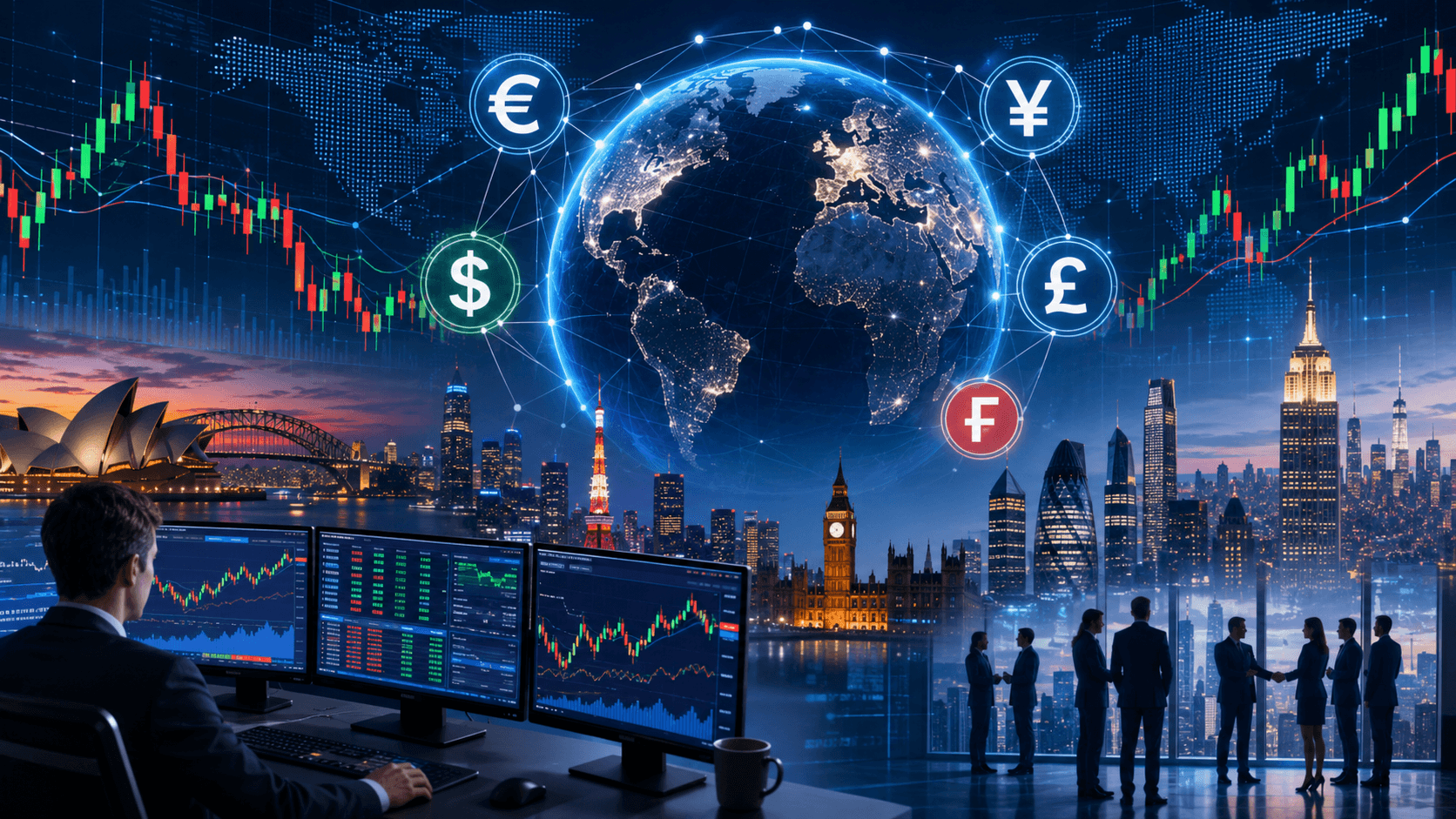
The FX market operates 24 hours a day, five days a week. Trading follows the sun across four major global sessions:
As one financial capital closes, another opens, ensuring a continuous loop of global liquidity.
Forex is an Over-the-Counter (OTC) market. There is no central clearinghouse or exchange. Instead, transactions occur electronically via an interconnected global network of banks, financial institutions, commercial corporations, hedge funds, and retail brokers.
Advancements in financial technology, online trading platforms, and mobile apps have democratized access to the FX market. Today, retail day traders can participate with minimal capital.
However, retail brokers frequently offer leverage—a mechanism that allows traders to borrow capital to control larger position sizes.
| Pros of Leverage | Cons of Leverage |
|---|---|
| Maximizes capital efficiency | Exponentially magnifies potential losses |
| Increases potential profit margins on small pip movements | Can lead to rapid margin calls and account liquidation |
Because of the high volatility associated with leverage, implementing strict risk management strategies—such as utilizing stop-loss orders and maintaining proper position sizing—is essential for capital preservation.
For beginners looking to build a foundation in market terminology, technical analysis, and price action, reputable and free educational platforms are highly recommended.
The BabyPips School of Pipsology is widely cited within retail trading communities (such as Reddit’s trading forums) as the benchmark starting point for novice traders. While structured educational courses are excellent for learning the theory, long-term success in currency trading ultimately requires hands-on experience, historical data backtesting, and disciplined psychological execution.
Yes, but regulation depends on the country. In the United States, retail forex trading is strictly regulated by the Commodity Futures Trading Commission (CFTC) and the National Futures Association (NFA). In the UK, it is overseen by the Financial Conduct Authority (FCA). Always ensure your chosen broker is licensed by a major tier-1 regulatory body.
The U.S. Dollar (USD) remains the undisputed king of global finance, featuring on one side of approximately 89% of all foreign exchange transactions.
Risk Disclaimer: Trading foreign exchange on margin carries a high level of risk and may not be suitable for all investors. The high degree of leverage can work against you as well as for you. Before deciding to trade foreign exchange, you should carefully consider your investment objectives, level of experience, and risk appetite.